
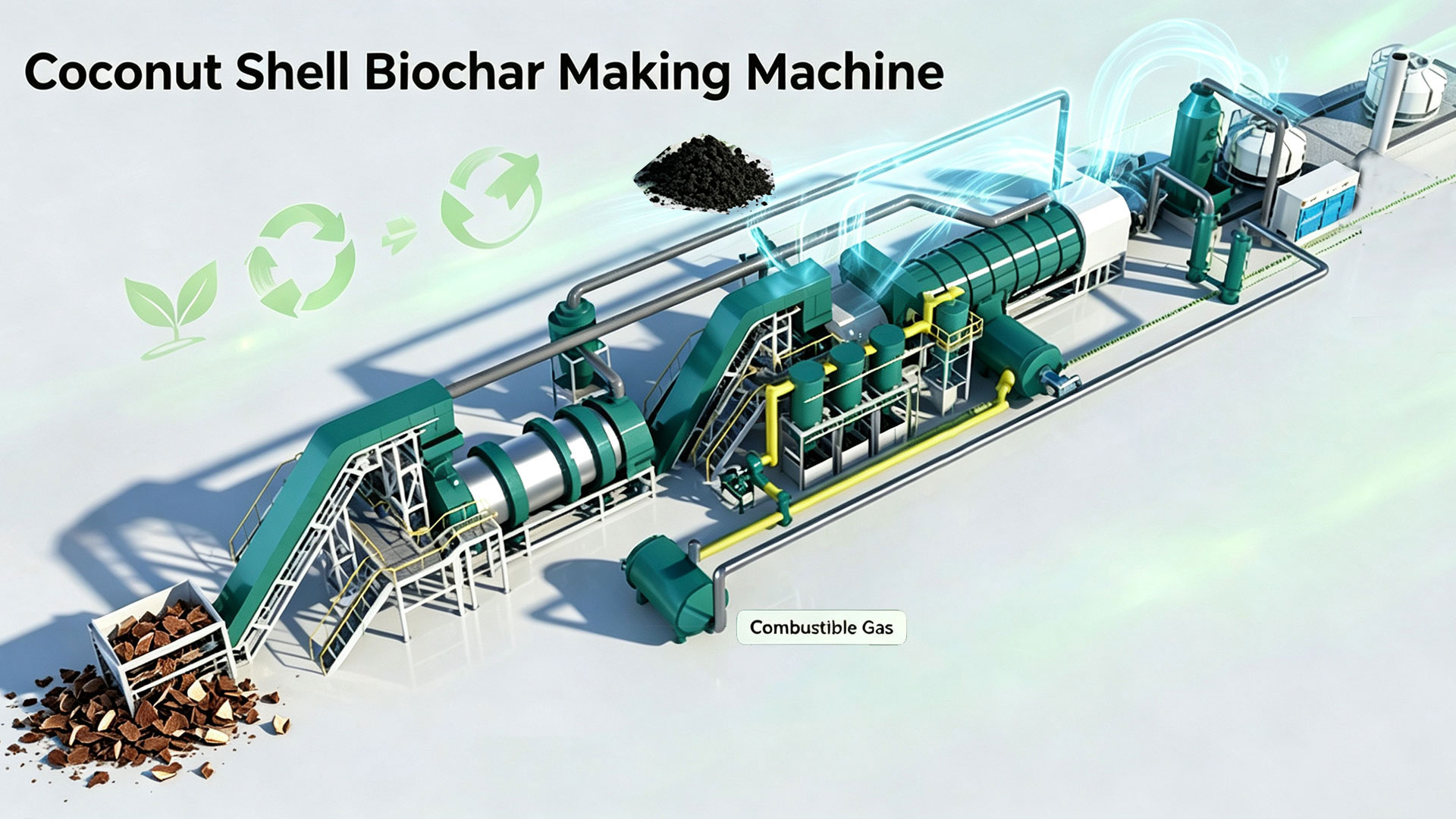
Palm and coconut waste represents massive, underutilized tropical biomass resources. Palm mill residues include empty fruit bunches (EFB), palm kernel shell (PKS), palm fronds and palm trunk scraps. Coconut waste mainly covers coconut shell, coconut husk (coir) and coconut processing leftovers. In Southeast Asia, Latin America and Pacific island regions, millions of tons of these residues are generated annually. Traditionally, most palm and coconut waste is stockpiled or openly burned, causing air pollution, methane emission and land occupation issues. A palm/coconut waste to biochar production plant adopts oxygen-limited slow pyrolysis technology, converting these tropical agro-industrial residues into premium biochar, recovering combustible syngas for self-heating, and building a circular economy solution for plantations and coconut processing factories.
Palm Coconut Waste to Biochar Solution
Palm Coconut Waste to Biochar solution utilizes pyrolysis carbonization to convert coconut shells into high-quality, high-density biochar. Mingjie biomass carbonization plant enables continuous production of biochar. Simultaneously, it achieves energy self-circulation by recovering syngas and heat. This ensures a stable, low-emission, and high-yield biomass-to-biochar conversion process.
Palm and coconut shell biochar is widely used in soil improvement, carbon sequestration, water treatment, environmental remediation, and as a high-quality activated carbon feedstock. Biomass carbonization equipment transforms abundant palm coconut waste into high-value-added products, supporting the circular economy and green development.
The core technology of this plant is slow pyrolysis, operated within 400–600 °C. After pre-treatment and drying, palm or coconut biomass enters a sealed reactor under low-oxygen or anaerobic conditions. Instead of full combustion, the organic matter undergoes thermal decomposition. Volatile fractions including syngas, tar and pyroligneous vapor are released and captured. The remaining solid carbon-rich product is palm or coconut biochar. Recovered syngas is burned to supply heat for the reactor and raw material dryer, so the whole line can achieve energy self-sufficiency after startup. High-temperature pyrolysis stabilizes the carbon structure and retains inherent mineral nutrients from palm and coconut biomass. Coconut shell and palm kernel shell produce biochar with especially high fixed carbon and low ash content, ideal for high-grade adsorbent materials.
Main Process Flow of the Production Plant
1. Raw Material Preprocessing Unit
Palm and coconut residues have diverse physical characteristics. EFB and coconut husk are fibrous with high moisture; palm kernel shell and coconut shell are hard, dense woody shells. This unit includes shredders, chippers, screening machines and rotary dryers. Long fibrous materials are cut into uniform fragments; stones, sand and plastic contaminants are removed. The dryer reduces feedstock moisture below 15% to ensure stable pyrolysis. Wet fibrous biomass consumes excessive heat and leads to unstable carbonization, so pre-drying is critical for tropical waste feedstock. Processed materials are stored in sealed silos before feeding.
2. Airtight Feeding System
Air-locked screw conveyors deliver dried palm/coconut material into the pyrolysis reactor. The air lock prevents ambient oxygen from leaking into the carbonization chamber. Oxygen ingress causes partial combustion, reduces biochar yield and brings safety risks. The feeding system can handle mixed feedstock, supporting co-carbonization of palm shell, coconut husk and EFB according to raw material availability.
3. Pyrolysis Carbonization Reactor
The reactor is the core equipment. Two main types are available:
- Batch carbonization kilns: Lower capital investment, simple operation. Suitable for small-scale decentralized sites near coconut farms or small palm mills. Limitations include intermittent operation, fluctuating biochar quality and lower syngas recovery.
- Continuous rotary pyrolysis furnace: Horizontal rotating cylinder with uniform mixing and precise temperature control. It runs 24/7 continuously and delivers consistent biochar quality, with high syngas capture efficiency. This is preferred for large palm oil mills, centralized biomass hubs and carbon credit projects requiring stable bulk supply.
Different feedstocks require adjusted temperature and residence time. Hard shell materials (palm kernel shell, coconut shell) need longer holding time to develop microporous structures, while fibrous EFB and coir husk require gentler heating to avoid over-decomposition.
4. Biochar Cooling, Crushing and Screening
Hot biochar exiting the reactor must go through airtight rapid cooling. High-temperature biochar will re-oxidize and burn once exposed to air, resulting in carbon loss. After cooling, biochar can be crushed and sieved into different particle sizes. It can also be pelletized for easier packaging and transportation. Coconut shell and palm shell biochar can be further activated by steam or chemical methods to produce high-performance activated carbon for water treatment.
5. Syngas Recovery and Flue Gas Purification System
Volatile gas generated in pyrolysis is condensed and purified. Clean syngas is combusted as heat source for drying and carbonization. Tar and pyroligneous liquid can be collected as co-products. Final flue gas passes through multi-stage dust removal, scrubbing and deodorization to meet local environmental emission standards. This eliminates smoke pollution from open burning of palm and coconut waste.
6. PLC Automatic Control System
Sensors monitor reactor temperature, pressure and oxygen concentration in real time. Operators adjust feeding speed, heating power and residence time on the control panel. The automatic system stabilizes operation, cuts labor input and improves safety, which is valuable for remote tropical plantation sites.
Unique Characteristics & Applications of Palm / Coconut Biochar
Compared with straw or rice husk biochar, palm kernel shell and coconut shell biochar has high fixed carbon, low ash and well-developed micropores. Coconut husk biochar features higher alkalinity, which works well for acidic soil remediation.
- Agricultural soil amendment: Improves soil aeration, water retention and cation exchange capacity. Reduces nitrogen and phosphorus leaching, promotes beneficial soil microbes. Widely used for oil palm plantation soil rehabilitation, orchard improvement and tropical degraded farmland restoration.
- Environmental remediation: Excellent adsorption performance for heavy metals, organic pollutants, dyes and ammonium nitrogen in wastewater and contaminated soil. Activated coconut / palm shell biochar is a premium filter medium for industrial water treatment.
- Carbon removal projects: Stable aromatic carbon can stay in soil for hundreds of years, eligible for carbon credit accounting under international carbon removal frameworks.
- High-value material feedstock: Raw biochar can be activated into commercial activated carbon, supercapacitor electrode materials and catalyst carriers.
Key Advantages of This Plant
- Feedstock flexibility: The line can process mixed palm and coconut residues, adapting to seasonal variations of tropical agro-waste.
- Energy self-sufficient: Pyrolysis syngas provides nearly all heat demand, minimizing external fuel cost.
- High-value product gradient: Produce agricultural biochar for soil application or upgrade to high-grade activated carbon for industrial markets.
- On-site deployment option: Plants can be built beside palm mills or coconut processing factories to avoid long-distance transport of bulky fibrous waste.
- Pollution replacement: Replaces open burning of plantation residues, cutting particulate emissions and greenhouse gas release.