
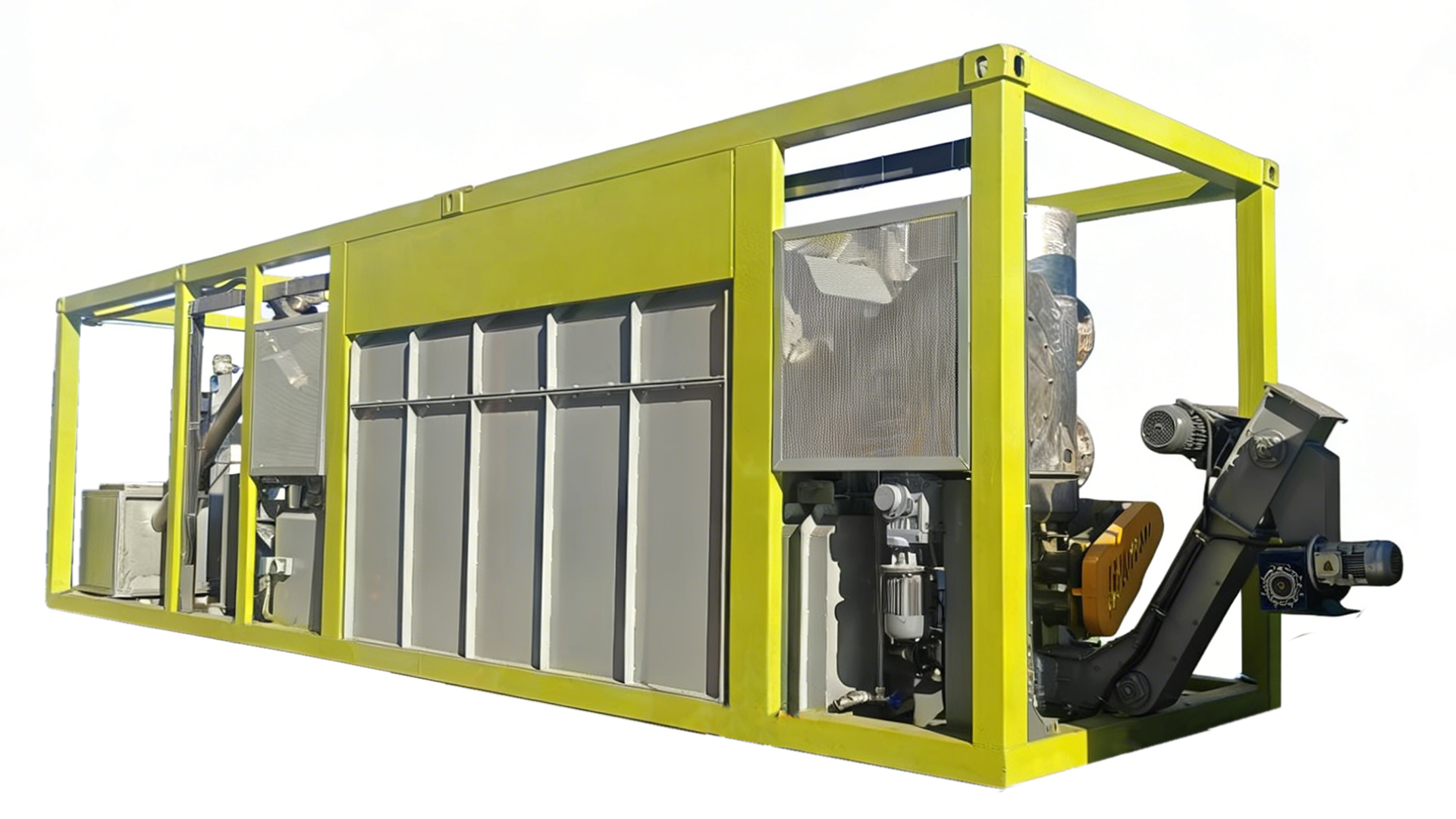
Our small mobile biochar production machine is designed to meet the needs of small-scale, flexible on-site production. It features a compact structure, easy mobility, simple operation, and low investment threshold. The MJT-100 biochar production equipment adopts a skid-mounted design and can process 50-100 kg/h of waste biomass.
Mobile Biochar Production Machine, mainly represented by the MJT-100 skid-mounted unit developed by Henan Mingjie Environmental Equipment Co., Ltd, is a compact, containerized continuous pyrolysis carbonization system specially designed for decentralized biomass waste treatment. Unlike large fixed industrial carbonization plants, this mobile biochar machine integrates the full production workflow on a standard skid base. It can be transported by container truck and deployed directly at farmlands, rice mills, bamboo processing yards, palm plantations and forestry residue sites, eliminating high logistics costs for bulky biomass feedstock. It turns local agricultural and forestry waste into high-quality biochar on-site, while recovering combustible syngas to sustain the thermal process, offering a flexible circular economy solution for small and medium-scale biochar and carbon sequestration projects worldwide.
Working Principle
The core technology of the mobile biochar machine is continuous slow pyrolysis under oxygen-limited conditions, operating at 400–600°C. After pre-shredding and drying to reduce moisture below 15%, biomass materials are fed into the sealed rotary reactor. With strictly controlled low-oxygen atmosphere, organic components in biomass undergo thermal decomposition instead of complete combustion. Volatile fractions including syngas, tar and pyroligneous vapor are separated and captured. The remaining solid output is high-performance biochar. The recovered syngas is burned to supply heat for the reactor and raw material dryer, making the machine largely energy self-sufficient after startup. High-temperature carbonization kills weed seeds and pathogens, realizing harmless treatment of crop residues while locking stable carbon inside biochar for long-term carbon removal.
Main Modules of Mobile Biochar Machine
The whole system is fully pre-assembled on one skid frame, enabling fast transportation and quick on-site installation with simple foundation work.
- Raw Material Preprocessing & Sealed Feeding Module It includes a small shredder, screening device and sealed air-lock screw feeder. Straw, rice husk, bamboo scraps, wood chips, coconut husk and palm residues can be processed after screening out stones and impurities. The air-lock feeding structure prevents air ingress into the reactor to avoid uncontrolled burning and biochar yield loss.
- Continuous Pyrolysis Carbonization Reactor The rotary carbonization reactor is the heart of the mobile unit. It supports 24-hour continuous feeding, carbonization and biochar discharging. The standard MJT-100 model runs at a processing capacity of 50–100 kg/h. Larger skid-mounted models such as MJT-500 and MJT-1000 are also available for higher throughput. Temperature and residence time can be adjusted to customize biochar properties for agriculture or adsorption applications.
- Airtight Biochar Cooling & Discharge Unit Hot biochar exiting the reactor enters an enclosed rapid cooling chamber to stop oxidation and prevent re-ignition when exposed to ambient air. Cooled biochar can be crushed and sieved directly on-site. Optional granulation accessories can be equipped to produce uniform biochar pellets for easier storage and transportation.
- Syngas Recovery and Flue Gas Purification System Pyrolysis syngas is captured and reused as internal fuel. Tar and pyroligneous liquid can be condensed and collected as by-products. The flue gas passes through multi-stage dust removal, scrubbing and purification before emission, meeting international environmental standards and eliminating smoke pollution caused by open biomass burning.
- PLC Automatic Control & Safety System Sensors monitor reactor temperature, pressure and oxygen concentration in real time. Operators can adjust feeding speed and heating parameters via the control panel. Built-in safety interlocks protect against over-temperature, over-pressure and oxygen leakage, lowering operation risks for field deployment.
Key Advantages of Mobile Biochar Production Machine
- High mobility & fast deployment Skid-mounted container-style design allows road transportation. It can be relocated between different waste sites according to seasonal biomass supply. Installation and commissioning take much less time compared with fixed carbonization plants.
- On-site biomass conversion Process agricultural residues directly at source. No need to transport low-density straw, husk or wood waste over long distances, cutting heavy freight expenses.
- Wide feedstock adaptability Compatible with rice husk, wheat/corn straw, wood chips, bamboo waste, coconut shell, palm EFB and other agroforestry residues, meeting diverse raw material conditions in different regions.
- Energy self-sufficiency Recovered pyrolysis gas supplies most heat demand; only auxiliary fuel is required during startup, greatly reducing running costs.
- Lower investment & flexible scaling Lower upfront capital than large stationary plants. It is ideal for new market entrants, smallholder cooperatives, plantations and pilot carbon credit projects to test biochar business models.
- Modular expandability Users can add drying, granulation or activation modules later to upgrade biochar from soil amendment grade to high-value adsorbent materials.