
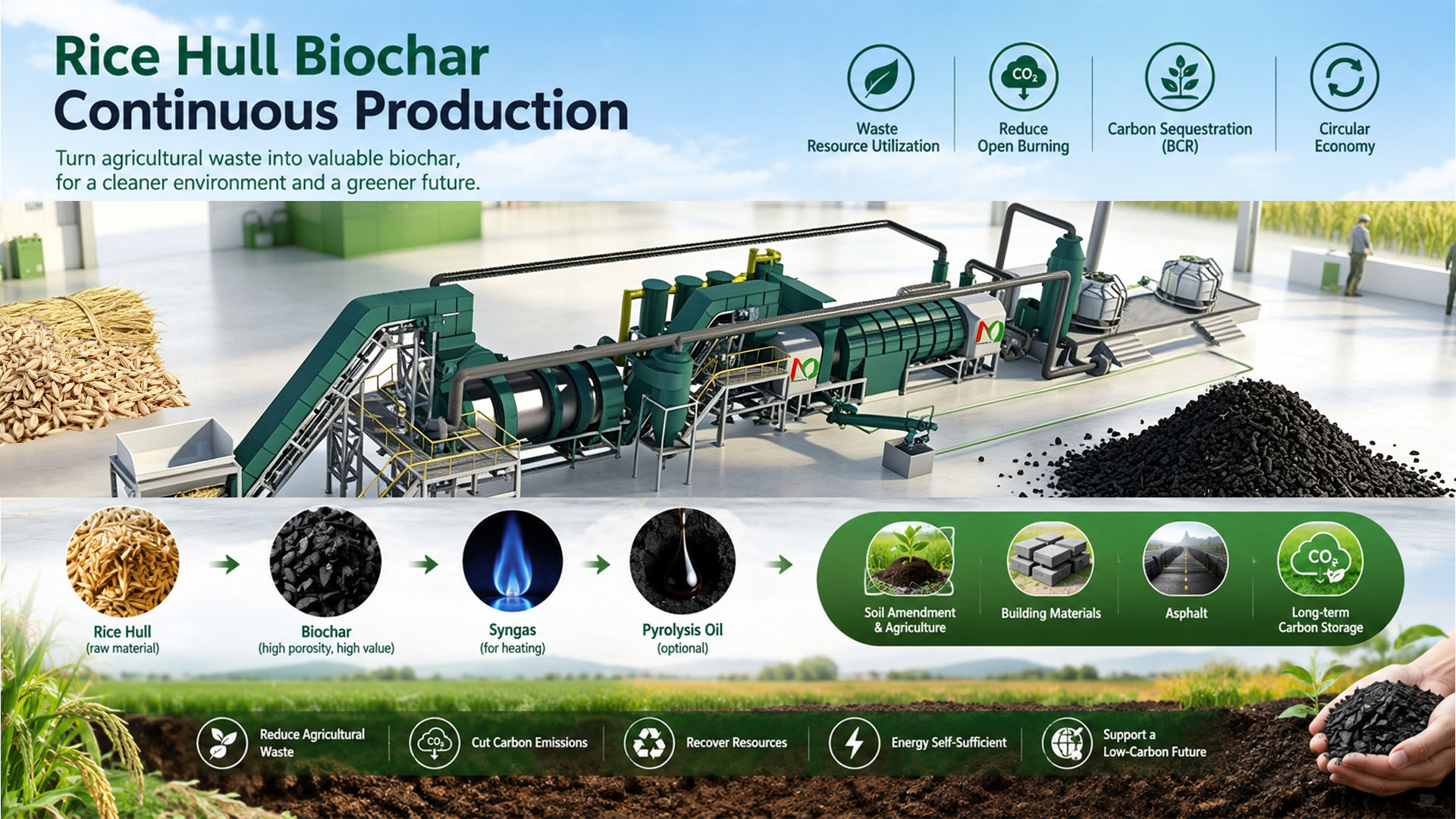
Rice husk biochar production equipment is a complete pyrolysis carbonization system specially designed to convert rice husk waste into high-quality biochar. Rice husk is a by-product generated in large quantities during rice milling. Without proper disposal, open burning of rice husks creates heavy smoke, particulate pollutants and greenhouse gas emissions. This set of equipment uses oxygen-limited slow pyrolysis technology to turn discarded rice husk into porous silica-rich biochar, while recovering combustible syngas to supply heat for the whole production line. It provides an integrated solution for waste treatment, carbon sequestration, soil amendment and circular economy development near rice mills.
Rice husk to biochar production equipment provides an efficient and environmentally friendly way to treat agricultural waste. The core of converting rice husks into biochar is through pyrolysis technology. Mingjie Biomass Carbonization Equipment can process rice husks at high temperatures in an oxygen-deficient environment, decomposing them into biochar, syngas, and bio-oil.
Our carbonization equipment is designed for continuous and stable operation. It can efficiently process large quantities of rice husks, achieving high yield, low energy consumption, and low emissions. The continuous carbonization system recovers syngas for the pyrolysis carbonization process, thus achieving complete energy recycling and full utilization of resources.
Working Principle
The core principle of rice husk biochar equipment is slow pyrolysis. Rice husk is heated inside a sealed reactor under low-oxygen or anaerobic conditions at 400–600°C. Instead of full combustion, organic components in rice husk thermally decompose. Volatile substances including syngas, tar and pyroligneous vapor are released and captured. The remaining solid carbon-rich material is rice husk biochar. The recovered syngas is burned as fuel to maintain reactor temperature and heat the raw material dryer, making the system largely energy self-sufficient and cutting external fuel costs.
Main Components of the Full Production Line
1. Raw Material Pretreatment Unit
This unit includes screening machine, shredder and rotary dryer. Rice husk is first screened to remove stones, metal fragments and plastic impurities. Since raw rice husk usually carries high moisture, the dryer reduces moisture content to below 15%. Too much moisture will consume extra heat, slow carbonization and lead to uneven biochar quality. The dried rice husk is stored in sealed silos before feeding.
2. Sealed Feeding System
Screw conveyors with air-locking devices transport dry rice husk into the reactor. The air lock prevents outside air from entering the carbonization chamber. If oxygen leaks in, rice husk will burn rather than carbonize, reducing biochar yield and causing safety risks.
3. Pyrolysis Carbonization Reactor
The reactor is the heart of the whole plant. Two mainstream types are widely used: batch kiln and continuous rotary carbonization furnace.
- Batch kilns: simple structure, low investment, easy installation for small-scale decentralized projects. But production is intermittent, temperature control is less precise and biochar quality fluctuates.
- Continuous rotary reactors: rotating horizontal cylinder, continuously mixing rice husk for uniform heating. Temperature and residence time can be precisely regulated. It supports 24-hour continuous running, stable biochar quality and high syngas recovery rate, suitable for medium and large industrial biochar and carbon credit projects.
4. Biochar Cooling, Crushing and Screening Unit
Hot biochar discharged from the reactor must go through airtight rapid cooling. Hot biochar will re-ignite when exposed to air, resulting in carbon loss. After cooling, the crude biochar can be crushed and sieved into different particle sizes according to customer requirements for agricultural application, wastewater adsorption or further activation treatment.
5. Syngas Recovery and Flue Gas Purification System
Volatile gas generated in pyrolysis is sent to condensation and purification modules. Cleaned syngas is delivered to the combustion chamber as heat source. Tar and pyroligneous liquid can be condensed and collected as by-products. The final flue gas passes through dust removal, scrubbing and decontamination before emission, meeting environmental protection standards and avoiding secondary pollution.
6. Automatic Control System
Sensors monitor temperature, pressure and oxygen concentration inside the reactor in real time. Operators can adjust feeding speed, heating power and residence time through the control panel. The automation system stabilizes operation, reduces labor cost and improves production safety.
Key Features of Rice Husk Biochar Equipment
- High adaptability for rice husk: The equipment is optimized for rice husk’s low bulk density and high silica characteristics. Uniform heating ensures well-developed porous structure of rice husk biochar.
- Energy self-supply: Reuse pyrolysis syngas for heating; only a small amount of auxiliary fuel is needed during startup.
- Modular design: Units can be assembled flexibly. Small skid-mounted systems fit rice mills with limited space; large turnkey lines are built for big biomass industrial parks.
- Environmentally friendly closed operation: No open burning; tar and dust are captured, reducing air pollution.
- Adjustable biochar performance: By tuning pyrolysis temperature, operators can produce biochar tailored for farm soil improvement or heavy metal adsorption.
Typical Application of Output Rice Husk Biochar
Biochar produced by this equipment contains abundant silica and porous microstructure.
- Agricultural use: improve sandy and acidic soil, retain water and nutrients, reduce fertilizer leaching and promote soil microbial activity.
- Environmental remediation: adsorb heavy metals and organic contaminants in wastewater and contaminated soil.
- Carbon removal projects: stable carbon in rice husk biochar can be accounted for carbon credit schemes.
- Advanced material feedstock: raw biochar can be activated to make low-cost adsorbent for water treatment.