
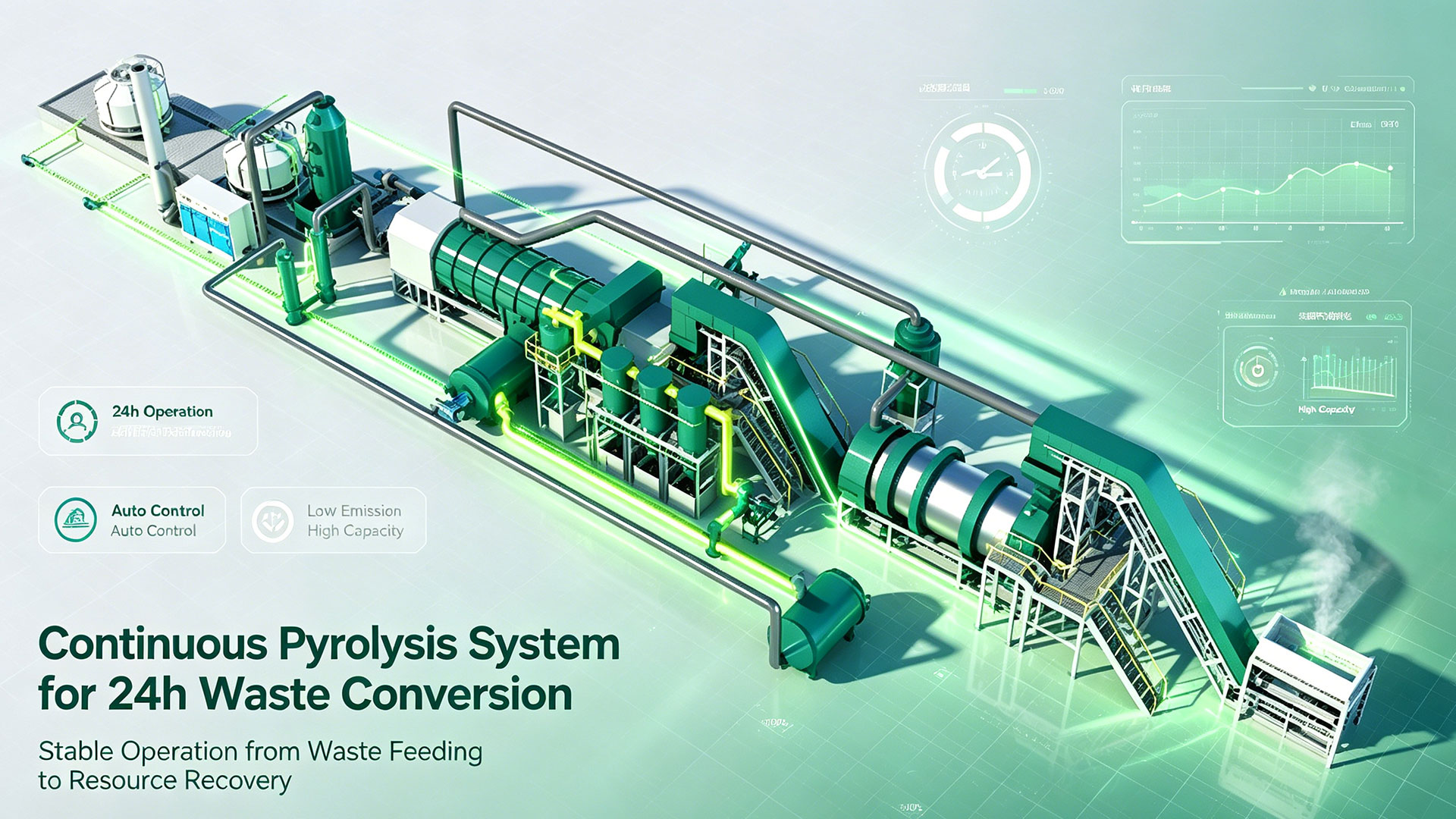
Wood pyrolysis carbonization plant is an industrial system that carbonizes woody feedstock under low or zero oxygen conditions. Unlike full combustion, pyrolysis heats biomass without burning it completely. The main solid output is biochar, a carbon-rich porous material. Meanwhile, volatile fractions are released as syngas and wood vinegar. These by-products can be recovered and reused to supply heat for the carbonization process, greatly reducing external energy consumption and improving the plant’s energy self-sufficiency.
What Is a Wood Pyrolysis Carbonization?
Wood biomass carbonization represents one of the most widely available renewable raw materials for biochar manufacturing. Forest thinning residues, sawdust, wood chips, bark and offcuts from timber processing are frequently left unused or burned in open air, releasing carbon dioxide and air pollutants. A wood pyrolysis carbonization plant is designed to convert these lignocellulosic wood wastes into stable biochar through oxygen-limited thermal decomposition. This facility delivers a circular economy solution that recovers energy, sequesters carbon and produces biochar for agriculture, environmental remediation and advanced material sectors.
Slow pyrolysis is the preferred technology for biochar production. It operates at temperatures between 400–600°C with relatively long residence time. This condition maximizes biochar yield and creates well-developed pore structures, which is critical for soil and adsorption applications. Fast pyrolysis prioritizes liquid bio-oil output and is less common when biochar is the primary target product.
Converting wood to biochar through pyrolysis is not only a waste treatment method, but also a systematic solution. Wood pyrolysis is essentially the process of chemically decomposing wood at high temperatures in an anaerobic environment. It balances environmental protection, economic benefits, and sustainable development.
Biomass carbonization plant separates volatile components from woody raw materials in a closed environment to produce high-purity biochar. Simultaneously, syngas and bio-oil are recovered, achieving high yield, low emissions, energy self-circulation, and stable quality.
Almost all types of wood can be pyrolyzed into biochar. This includes softwoods (pine, cedar), hardwoods (oak, eucalyptus), and wood processing residues (sawdust, branches). Although the chemical composition (cellulose, lignin content) varies among different tree species, their carbonization rates during pyrolysis are essentially the same.
Main Process Flow of the Carbonization Plant
- Raw Material Handling & Pre-treatment
Wood residues are first screened to remove stones, metals and impurities. Oversized logs are chipped into uniform wood chips. Wet wood is sent to a drying system to reduce moisture content. High moisture wastes heat input, extends carbonization time and reduces biochar quality. For continuous plants, the dried wood chips are stored in feeding hoppers with sealed conveyors to prevent air ingress. - Feeding & Pyrolysis Carbonization Reactor
Sealed screw feeders transport dry wood biomass into the carbonization reactor. The reactor maintains an oxygen-deficient environment. As temperature rises, wood components (cellulose, hemicellulose and lignin) break down. Hemicellulose decomposes first, followed by cellulose. Lignin decomposes more slowly and forms the main carbon skeleton of biochar. Volatile gases are drawn out from the reactor chamber. - Biochar Cooling & Discharge
Hot biochar exiting the reactor must be rapidly cooled in an airtight cooling section. Direct contact with air at high temperature will cause the hot char to re-ignite and oxidize, which destroys product yield. After cooling, the biochar is discharged, crushed and screened to obtain particle sizes matching customer requirements. It can be bagged directly or further activated for high-end adsorption use. - By-product Recovery & Flue Gas Treatment
Volatiles from the reactor contain combustible syngas, tar and wood vinegar. Syngas can be burned in a combustion chamber to supply heat for the reactor and dryer. Tar and wood vinegar can be condensed and collected as co-products. Remaining flue gas goes through dust removal and purification before emission, ensuring the plant meets environmental standards.
Core Advantages of Wood-derived Biochar
Wood biochar features high carbon content and stable aromatic carbon structures, which can remain in soil for hundreds to thousands of years. Its porous structure retains water and nutrients, improves soil aeration and provides habitats for beneficial microorganisms.
- For agriculture: Wood biochar improves poor sandy or compacted soil, reduces nutrient leaching, enhances crop resistance to drought and cuts fertilizer demand.
- For environmental remediation: It adsorbs heavy metals and organic contaminants in soil and wastewater.
- For carbon projects: Carbon locked inside biochar qualifies for carbon removal accounting under multiple carbon credit frameworks.