
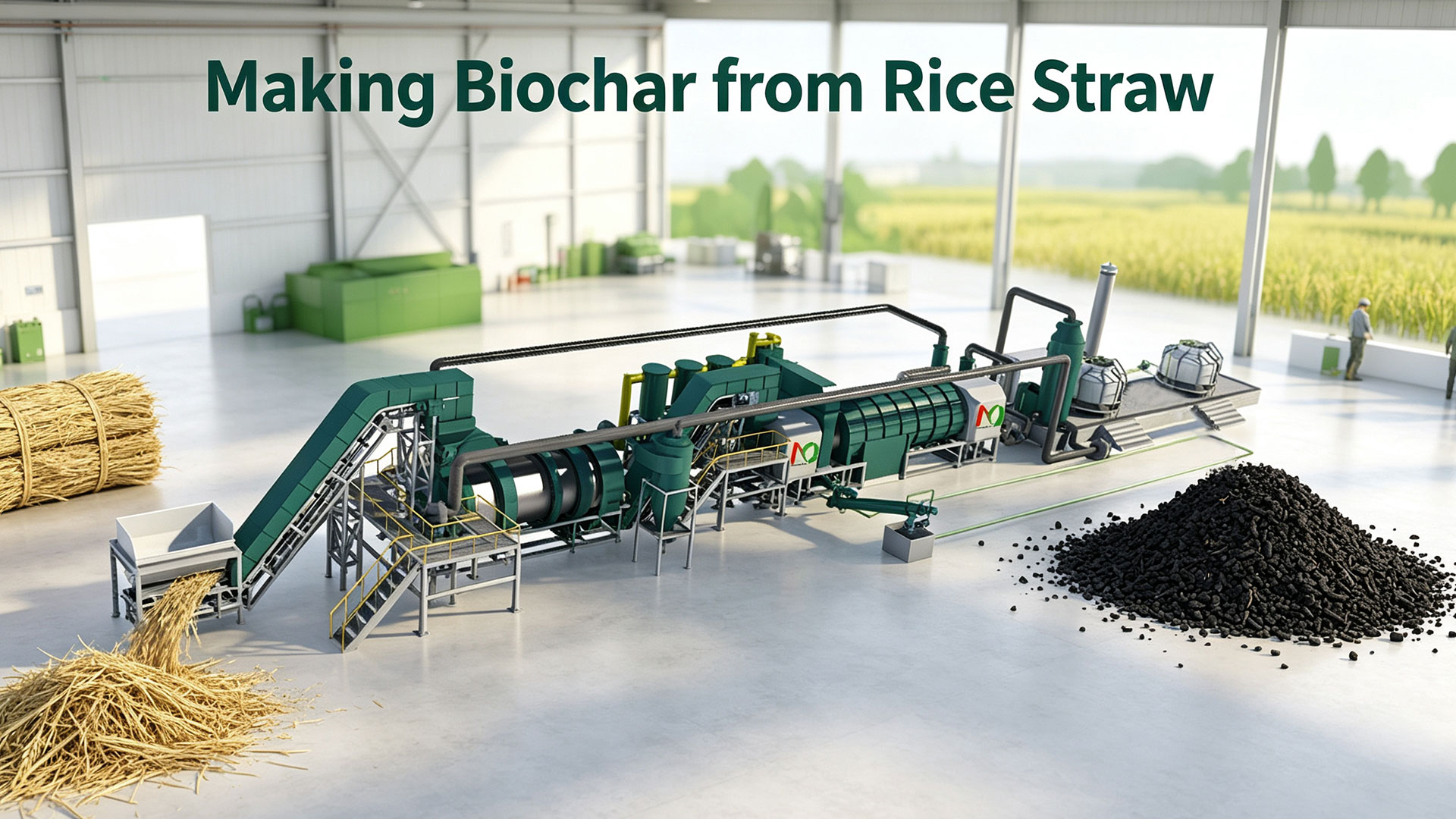
Straw is one of the most abundant lignocellulosic agricultural residues on the planet. Wheat straw, corn straw, rice straw and other crop stalks are produced in massive quantities every harvest season. Traditionally, large volumes of straw are burned openly in farmlands, releasing particulate matter, greenhouse gases and volatile pollutants, which trigger air pollution and waste biomass resources. A straw pyrolysis carbonization plant is designed to thermally convert straw waste into stable biochar under oxygen-limited conditions. This system realizes harmless disposal of crop residues, soil improvement, on-site carbon sequestration, and creates economic benefits for farmers and biomass operators.
Straw to biochar solutions help achieve goals such as waste reduction, resource recycling, carbon neutrality, and sustainable circular development. Straw biochar is widely used in soil improvement, carbon sequestration, organic farming, and environmental remediation.
What Is a Straw Pyrolysis Carbonization Plant?
A straw pyrolysis carbonization plant is an industrial facility for turning agricultural straw into biochar via controlled carbonization. Unlike combustion which fully oxidizes biomass into CO₂, pyrolysis heats straw in an environment with little or no oxygen. The solid output is biochar; meanwhile, volatile components are separated into combustible syngas, tar and wood vinegar. The recovered syngas can be reused as fuel to provide heat for the carbonization reactor and raw material dryer, lowering external energy consumption and improving the plant’s energy self-balance.
Slow pyrolysis is the dominant process for straw biochar production. The typical operating temperature range is 400–600 °C with extended residence time. This condition maximizes biochar yield and forms abundant pore structures. Compared with fast pyrolysis, which prioritizes bio-oil production, slow pyrolysis is more suitable when biochar is the primary target product.
Main Process Flow of Straw Carbonization Plant
Raw Material Preprocessing
Straw has low bulk density and high moisture, which brings challenges to transportation and carbonization. First, the raw straw is collected, crushed and shredded into uniform short segments. Impurities such as soil, stones and plastic fragments are screened out. Then the shredded straw enters a drying system to reduce moisture content. Excess moisture will consume extra heat, prolong carbonization cycles and reduce biochar quality. After drying, the straw is stored in sealed feeding bins to prevent air infiltration.
Feeding and Pyrolysis Carbonization
Sealed screw conveyors feed dry straw into the carbonization reactor. Inside the reactor, oxygen is strictly restricted. As temperature rises, cellulose, hemicellulose and lignin in straw decompose sequentially. Hemicellulose breaks down at lower temperatures, cellulose decomposes at medium temperatures, while lignin forms the main carbon framework of straw biochar. Volatile flammable gas is extracted from the reactor chamber continuously.
Biochar Cooling and Discharging
Hot biochar leaving the reactor must go through airtight rapid cooling. High-temperature biochar will re-oxidize and burn once exposed to air, resulting in product loss. After cooling, biochar is discharged. It can be further crushed, sieved and packed according to different application requirements. It can also be chemically modified to enhance adsorption capacity for wastewater and soil remediation projects.
By-product Recovery and Flue Gas Purification
Volatiles generated during straw pyrolysis contain syngas, tar and wood vinegar. Syngas is burned in a combustion chamber to supply heat for the whole plant. Tar and wood vinegar can be condensed and collected as valuable by-products. The remaining flue gas passes through dust removal and purification equipment before discharge, complying with environmental emission standards.