
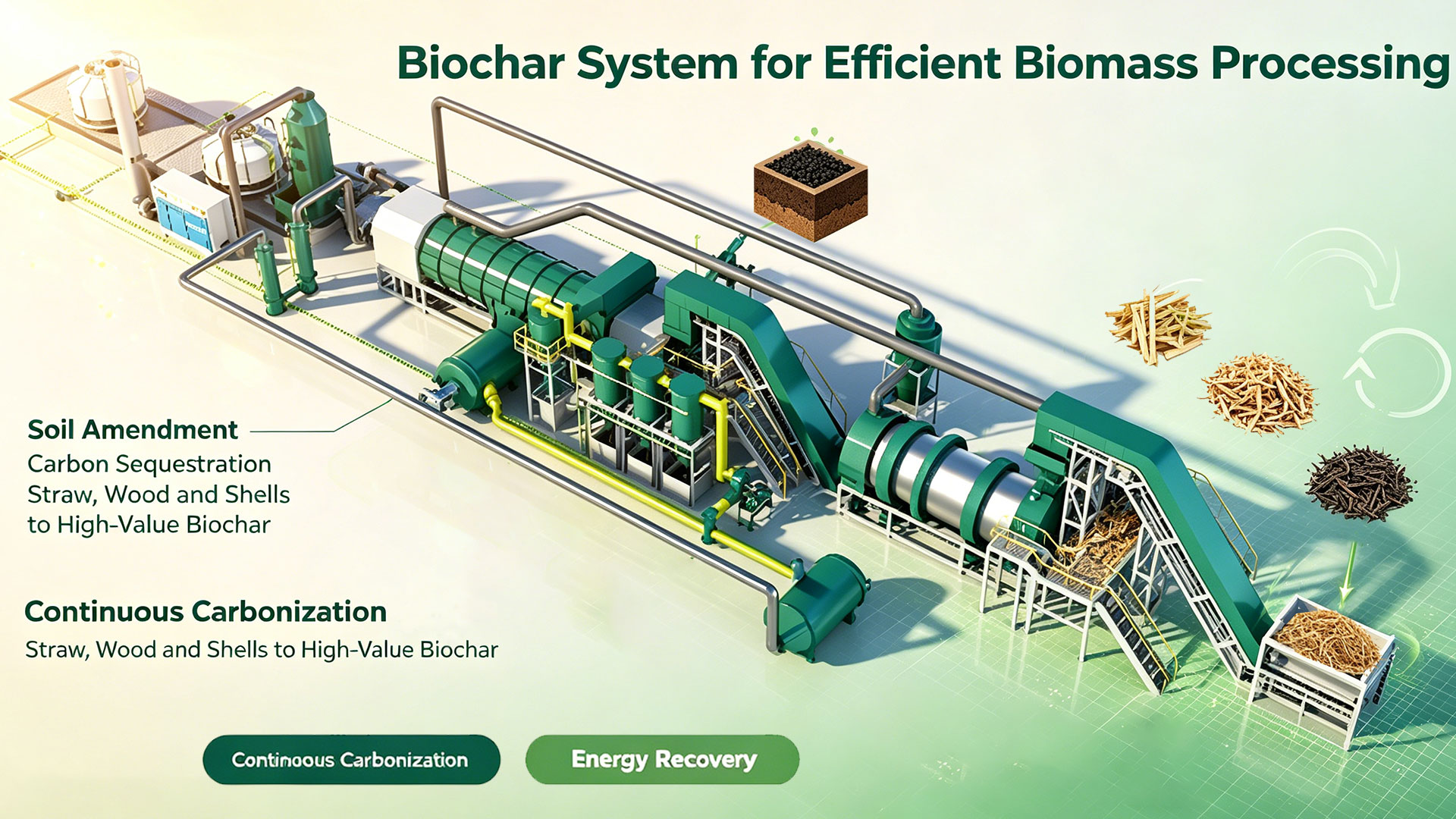
Designed for large-scale industrial production, our continuous biochar production equipment emphasizes high efficiency, high output, and intelligent operation. These equipment are primarily used in large-scale biomass recycling companies and industrial waste treatment projects, enabling continuous biomass processing and large-scale biochar production.
Large scale continuous biochar production equipment is a full industrial turnkey pyrolysis carbonization system built for mass, uninterrupted conversion of biomass waste into standardized biochar. Unlike batch kilns or small mobile skid-mounted machines, this stationary large-scale line is designed for 24/7 continuous operation, with daily biomass processing capacity generally ranging from 10 tons up to over 100 tons. It is deployed in centralized biomass industrial parks, large rice mills, palm oil complexes, forestry processing bases and sludge disposal hubs. The system adopts controlled low-oxygen slow pyrolysis, realizes energy self-circulation via syngas recovery, and produces consistent high-grade biochar that meets international standards such as EBC and ISCC for soil amendment, environmental remediation and carbon credit projects.
Working Principle
The core of large-scale continuous biochar equipment is slow pyrolysis inside a sealed rotary reactor, operating steadily within 400–600°C. After pre-treatment and drying, biomass feedstock is continuously fed into the reactor under micro-negative pressure and oxygen-limited conditions. Organic components undergo thermal decomposition instead of full combustion. Volatile products including syngas, tar and pyroligneous vapor are extracted and separated. The solid carbon-rich output is biochar. Recovered combustible syngas is burned to supply heat for the reactor and raw material dryer, making the plant largely self-sufficient in thermal energy after startup. Precise temperature and residence time control ensures uniform carbonization, stable pore structure and fixed carbon content of biochar. High-temperature treatment also eliminates weed seeds, pathogens and harmful organic contaminants in raw materials.
Main Units of the Full Production Line
1. Centralized Raw Material Preprocessing System
This is the front-end large-volume processing section, including receiving hoppers, conveyors, shredders, magnetic separators, screening machines and large rotary dryers. It removes stones, metal, plastic and other impurities, crushes bulk biomass into uniform particle size, and reduces feedstock moisture to below 15%. The system can handle mixed feedstocks such as wood chips, straw, rice husk, bamboo scraps, palm residues, coconut shells and organic sludge. Covered raw material silos store dried biomass to guarantee stable continuous feeding and avoid moisture reabsorption.
2. Airtight Continuous Feeding System
Multiple sets of air-lock screw feeders deliver dried biomass into the reactor. The air-lock and micro-negative pressure design strictly prevent outside air infiltration. Oxygen leakage would cause uncontrolled combustion, reduce biochar yield, trigger temperature runaway and create safety risks. Variable-speed feeding allows operators to adjust throughput according to feedstock quality and target biochar grade.
3. Rotary Pyrolysis Carbonization Reactor
The horizontal rotary reactor is the heart of the whole large-scale line. The rotating cylinder continuously mixes and transports biomass through different heating zones, realizing even heating and carbonization. Multi-zone temperature control enables independent adjustment of drying, preheating, pyrolysis and carbonization sections. It runs non-stop day and night, delivering consistent biochar quality, much higher processing efficiency and syngas recovery rate than batch kilns. Wear-resistant lining materials are adopted to resist abrasion from high-ash biomass such as rice husk and sludge.
4. Continuous Biochar Cooling, Milling and Granulation Unit
Hot biochar discharged from the reactor enters a fully enclosed rapid cooling jacket to stop oxidation and prevent re-ignition upon exposure to air. Cooled raw biochar is sent to crushing and screening modules to produce different particle sizes. Optional large granulation equipment can manufacture biochar pellets, which are convenient for bulk packaging, long-distance transportation and commercial trading.
5. Syngas Recovery & Multi-stage Flue Gas Purification System
Volatiles generated during pyrolysis go through condensation, tar trapping and gas washing. Clean syngas is recycled as fuel for the thermal system. Tar and pyroligneous liquid can be captured as saleable by-products. Flue gas passes through cyclone dust removal, scrubber, deacidification and activated carbon adsorption before emission. This advanced treatment meets strict industrial environmental regulations and eliminates smoke, odor and toxic secondary pollutants, critical for large industrial projects.
6. Central PLC Intelligent Control & Safety Interlock System
Sensors continuously monitor temperature, pressure, oxygen concentration, feed rate and flue gas composition across the whole line. Operators supervise and adjust all parameters on the central control panel. The system records full production data for quality traceability and carbon credit verification. Built-in safety interlocks trigger automatic alarm and protection for over-temperature, over-pressure and abnormal oxygen spikes, greatly reducing operational risks for long-running industrial operation.
Core Advantages of Large Scale Continuous Biochar Equipment
- 24-hour continuous stable production: High throughput and consistent product quality, suitable for bulk commercial biochar supply and carbon removal projects requiring large-volume certified biochar.
- Excellent energy recycling: Syngas self-heating cuts external fuel consumption and lowers long-term operating costs.
- Wide feedstock flexibility: Capable of processing multiple types of agroforestry waste and organic sludge in single or mixed feeding mode.
- High automation & low labor intensity: Centralized control reduces manual operation and improves production repeatability.
- Compliant emission control: Complete gas purification system meets strict industrial environmental standards for long-term factory operation.
- Scalable modular design: Units can be expanded step-by-step, with optional modules for biochar activation, fertilizer compounding and by-product deep processing.
Biochar production equipment is an essential tool for achieving long-term carbon sequestration. Through continuous pyrolysis technology, it transforms unstable organic carbon in waste biomass into highly stable biochar. The entire biomass carbonization system enables measurable and verifiable net negative emissions. As a professional manufacturer of continuous biochar production equipment, we are committed to helping build a sustainable and climate-resilient future.
Biochar carbon removal (BCR) is a negative emissions technology that has been endorsed by the Intergovernmental Panel on Climate Change (IPCC). Biomass carbonization plant uses agricultural, forestry, or other waste biomass to produce biochar. The biochar is then applied to soil or added to durable materials such as cement and asphalt.
Unlike biomass decomposition, which releases CO2, biochar can sequester carbon dioxide for hundreds, thousands, or even longer. Furthermore, biochar carbon removal creates a significant source of funding for producers through voluntary carbon markets.